Guide
A horse that will not lie down is not sleeping properly.
Horses doze standing up, which is why the problem goes unnoticed. The part of sleep they cannot get on their feet is the part that eventually forces the issue.
Guide
Horses doze standing up, which is why the problem goes unnoticed. The part of sleep they cannot get on their feet is the part that eventually forces the issue.
Ask most people how horses sleep and they will tell you horses sleep standing up. It is half right, and the missing half is the part that causes problems.
A horse can lock the major joints of its limbs through an arrangement of tendons and ligaments known as the stay apparatus, supporting its weight with very little muscular effort. This is a prey animal's adaptation: it allows rest without giving up the ability to move immediately, and it is why a horse can stand for long periods and doze.
What it allows is drowsiness and slow-wave sleep. What it cannot allow is REM.
REM sleep involves near-total loss of muscle tone — atonia. That is not incidental to REM; it is one of the things that defines it. A horse in REM cannot hold itself up, because the mechanism that holds it up depends on muscle tone that REM removes. So REM requires lying down. In practice it usually requires lateral recumbency, flat on the side, or at least a sternal position with the head supported.
Horses are polyphasic sleepers. Rather than one consolidated block, they take sleep in many short periods across the day and night, with the majority of recumbent sleep occurring at night. Total sleep is only a few hours in twenty-four, and the recumbent portion of it is smaller again — commonly cited in the region of thirty to sixty minutes a day, taken in bouts of a few minutes at a time.
That is a small requirement, and it is easy to assume it is being met. It is also small enough that a horse can miss it for days without anybody noticing, because a horse that has not lain down looks exactly like a horse that has.
Recumbency is a decision the animal makes, and it can be prevented by anything that makes getting down or getting up again feel unsafe or painful.
A REM-deprived horse eventually enters REM while standing. Muscle tone goes, and the horse partially or completely collapses — often buckling at the knees, sometimes going all the way down, usually catching itself and coming straight back up. It typically happens while the horse is standing quietly rather than while active.
These episodes are frequently reported as fainting, as a neurological problem, or as narcolepsy. True narcolepsy in horses exists but is rare and usually appears in young animals. Sleep deprivation is very much more common and is, importantly, reversible: the collapses stop when the horse starts lying down again.
The signs worth looking for before it gets that far are physical. Repeated abrasions on the front of the fetlocks and knees, from buckling. Bedding that is never disturbed. Hocks and hips with no shavings on them in the morning. A horse that seems dull or unusually spooky without an obvious cause.
Most of the fixes are unglamorous and cheap. A bigger box or an overnight turnout. Deeper bedding, and enough of it that the horse can get up without scrabbling. A companion, or a stable position with a neighbour it settles beside. A pain workup if the horse is older or has a known joint history. On competition trips, stabling that resembles home more than it resembles a corridor.
The difficulty is knowing whether any of it worked. Recumbency happens at night, in short bouts, and stable cameras produce hours of footage that nobody watches to the end.
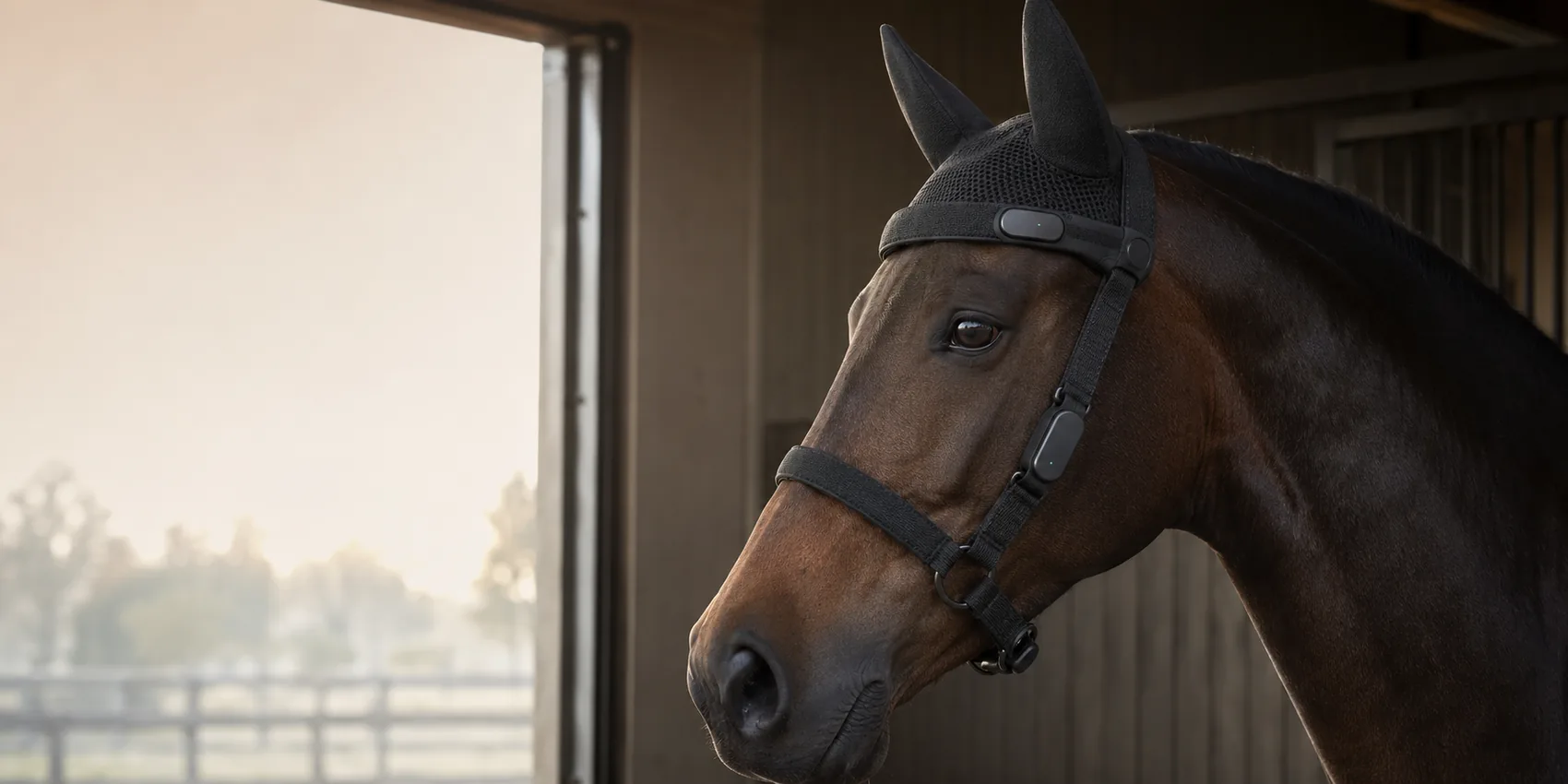
That is the measurement problem Ninug Equine is built for: recumbency logged continuously rather than sampled, so "he seems better since we moved him" becomes a number of minutes per night with a date attached. The same record covers travel and competition load, and recovery through a period of box rest — the situations where the debt accumulates fastest and is hardest to see. It is fitted and supported by a professional, and reserved through the shop like everything else.
For other species the questions are different but the principle is the same — continuous, objective monitoring for animals that cannot tell you how they feel. The overview is here, and there are separate pages for dogs and cats and for cattle, sheep, pigs and goats.
Further reading