Focus at work

Your best two hours are not when you think.

Most productivity advice is someone else's routine, generalised. Ninug measures when your attention actually holds, what conditions it holds in, and when you have run out — for you, not for an average person.
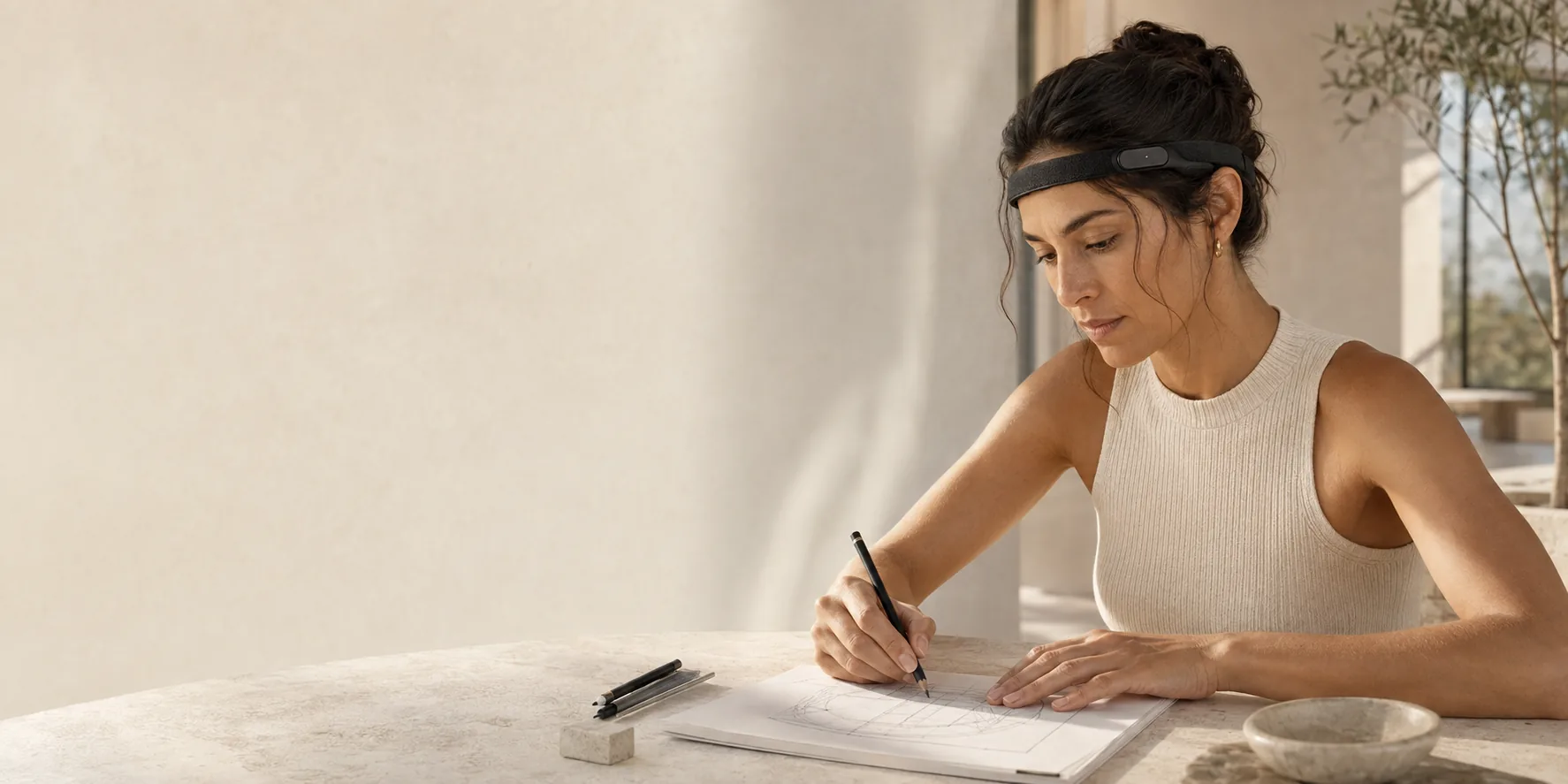
A person concentrating at a desk wearing the Ninug band

The measurement

Focus is a variance, not a level.

Nobody concentrates in a flat line. Attention drifts out and comes back, dozens of times an hour. What separates a good working session from a bad one is not peak intensity — it is how often you drift, and how long it takes to return.

So we do not show you a live “focus percentage.” Watching a number like that is itself a distraction, and it turns work into a performance for a sensor. You get the session afterwards:

“You held focus for 41 of 52 minutes, with six drifts — most of them after minute 35.”

What it is for

Four things worth knowing about your own working day.

When to schedule the hard thing

Everyone has a window where difficult work is genuinely easier. After a few weeks the pattern is unambiguous, and it is frequently not the one you would have guessed. Protecting that window is the highest-leverage change most people can make.

What the room is costing you

Poorly ventilated rooms measurably degrade cognitive performance, and a closed meeting room with six people in it gets there fast. The Ninug Room sensor makes the effect visible, and the fix is usually free — open a window.

When you are done

Mental fatigue shows up in the signal before it shows up in how you feel. Knowing you are past the point of useful work is worth more than another hour of pretending otherwise.

How last night is showing up today

The clearest, most repeatable finding in personal data: short nights land in the afternoon, not the morning. Once you can see it, the trade-off you are making at 1am stops being abstract.

Also for

Two groups this matters more to.

ADULTS WITH ADHD

Diagnosed late, or never

Running the same experiment on yourself for years with no instruments — trying routines, blaming willpower, never knowing which change did anything. Objective session data turns that into something you can actually iterate on. We do not treat ADHD and we do not diagnose it; we measure the conditions under which your attention holds.

SHIFT & SAFETY-CRITICAL WORK

When being tired is a hazard

Slow eye movements, long closures and head nods are the clearest signals we can read, and they arrive before someone knows they are going. For drivers, operators and clinical night staff, a short-horizon drowsiness warning is a different category of useful.

  • The employer sees a flagFit to work, or not. Nothing underneath it
  • Never brain dataNot sleep detail, not off-shift hours, not stress, not focus scores
  • Told in advance, in plain languageAnyone asked to wear one at work sees exactly what is shared before they put it on

If your employer buys it

A brain sensor at work is a serious thing to ask of someone.

Fatigue management is a real safety need and a real market. It is also the easiest way for a company like ours to end up building surveillance, so the boundary is written into the product rather than the terms of service.

For teams and for one desk.

Individual bands ship first. If you run a fleet, a plant or a night-shift operation and want to talk about fatigue monitoring, we would like to hear from you early.