Guide
A headband is not a small EEG lab.
Every convenience that makes a wearable wearable takes something away from the recording. Knowing which things it takes is the difference between using one well and believing whatever it prints.
Guide
Every convenience that makes a wearable wearable takes something away from the recording. Knowing which things it takes is the difference between using one well and believing whatever it prints.
Clinical EEG is done with twenty-one or more gelled electrodes, placed by someone trained to place them, on skin that has been prepared, in a room chosen for electrical quiet. A wearable has a few dry contacts at fixed positions, put on by the wearer in a bedroom, next to a phone charger.
Both are EEG. They are not equivalent, and the gap is not a matter of polish.
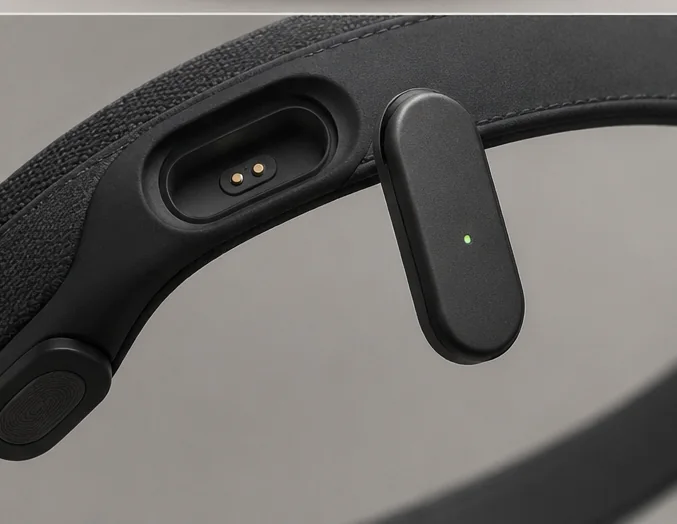
Dry contacts instead of gel. Conductive gel fills the gap between metal and skin and drops contact impedance by an order of magnitude. Dry electrodes skip it, which is the only reason a device can be put on in five seconds, and they pay for it with a higher and less stable impedance — which means more mains pickup and more sensitivity to movement. See EEG electrodes for the detail.
Few channels. Most headbands have between one and four. With one channel there is no spatial information at all — you cannot tell front from back or left from right, and you cannot use the comparison between channels to identify an artefact, which is one of the main ways a technician spots one.
Fixed positions, usually the forehead. A band goes where a band can go. That means the forehead, which is the easiest place to reach skin without hair and the worst place for most of the rhythms people want to read. Alpha is strongest occipitally, at the back. The forehead is close to the eyes and directly over the frontalis muscle.
An uncontrolled environment. A laboratory keeps mains hum, phone chargers, movement and light under control. A bedroom does not.
This is the useful question, and it has real answers.
Eye movement and blinks. Blinks are the largest thing a forehead electrode sees by a wide margin — hundreds of microvolts against tens for the EEG underneath. In a clinical recording that is an artefact to be removed. On a forehead band it is a reliable, verifiable signal in its own right, and slow rolling eye movements are one of the clearest markers of falling asleep.
Muscle tension. Frontalis and the jaw sit directly under a band, and EMG is broadband and large. Jaw clenching is unmistakable.
Slow activity during sleep. Delta is large, low-frequency and reasonably widespread, which makes it the most forgiving thing to record badly. Wake-versus-sleep is a much easier discrimination than four-stage sleep architecture.
Gross state changes. Awake, drowsy, asleep. Not "which stage, to the minute".
Sleep staging. A device that reports light, deep and REM in minutes is making a strong claim, and the only way to know whether it is right is comparison against polysomnography scored by a human — the reference standard, itself only about 80–90% agreement between two expert scorers.
Some research-grade wearables have been validated this way and published the agreement figures. Many consumer devices have not, and describe their output in the same four words regardless. The question worth asking of any device is not whether it reports stages but what it was compared against, and how well it agreed.
Nights. A sleep laboratory gives you one or two nights, in an unfamiliar bed, wired up — and the first night in a lab is measurably atypical, which is a known enough effect to have a name. A wearable gives you a hundred nights at home, and for anything that varies night to night, a long ordinary record beats a short excellent one.
The same applies to anything infrequent. A pattern that appears twice a month will not show up in a single overnight study.
Further reading