Guide
Almost every bad EEG recording is a contact problem.
The electrode is where a chemical world meets an electrical one. Nearly everything that goes wrong in a recording goes wrong at that boundary, and it is the one part a wearer can influence.
Guide
The electrode is where a chemical world meets an electrical one. Nearly everything that goes wrong in a recording goes wrong at that boundary, and it is the one part a wearer can influence.
An EEG electrode does something less obvious than it appears. Inside the body, charge is carried by ions in solution. In a wire, it is carried by electrons. The electrode is the interface where one becomes the other, and how cleanly that conversion happens sets the quality of everything downstream.
The standard clinical electrode is silver coated with silver chloride, and it is standard because of a specific electrochemical property: it is a non-polarisable electrode. Charge crosses the interface by a reversible chemical reaction rather than accumulating as a charged layer.
The practical consequence is stability at low frequencies. A polarising electrode builds up a slowly drifting offset voltage that wanders across the recording — and since much of the interesting EEG is below 4 Hz, drift and signal occupy the same range. Ag/AgCl drifts far less, which is why it survives despite being neither the cheapest nor the most durable option.
Contact impedance is the resistance to alternating current at the electrode–skin boundary, measured in ohms. Clinical practice traditionally aims below 5 kΩ, with modern high-impedance amplifiers tolerating considerably more.
What impedance actually costs you is not signal — the amplifier has very high input impedance, so the brain signal arrives nearly intact either way. What it costs is common-mode rejection. A differential amplifier removes interference by subtracting what is common to two inputs, and that subtraction only works when the two inputs are balanced. Unequal impedances unbalance them, and mains hum that should have cancelled survives instead.
Wet. Conductive gel or paste fills the microscopic gaps between metal and skin and hydrates the outer skin layer, which is the resistive part. Impedance drops by an order of magnitude. It is the best contact available and it is unpleasant: it takes time to apply, it needs the skin abraded first, it dries out over hours, and it leaves the hair needing washing.
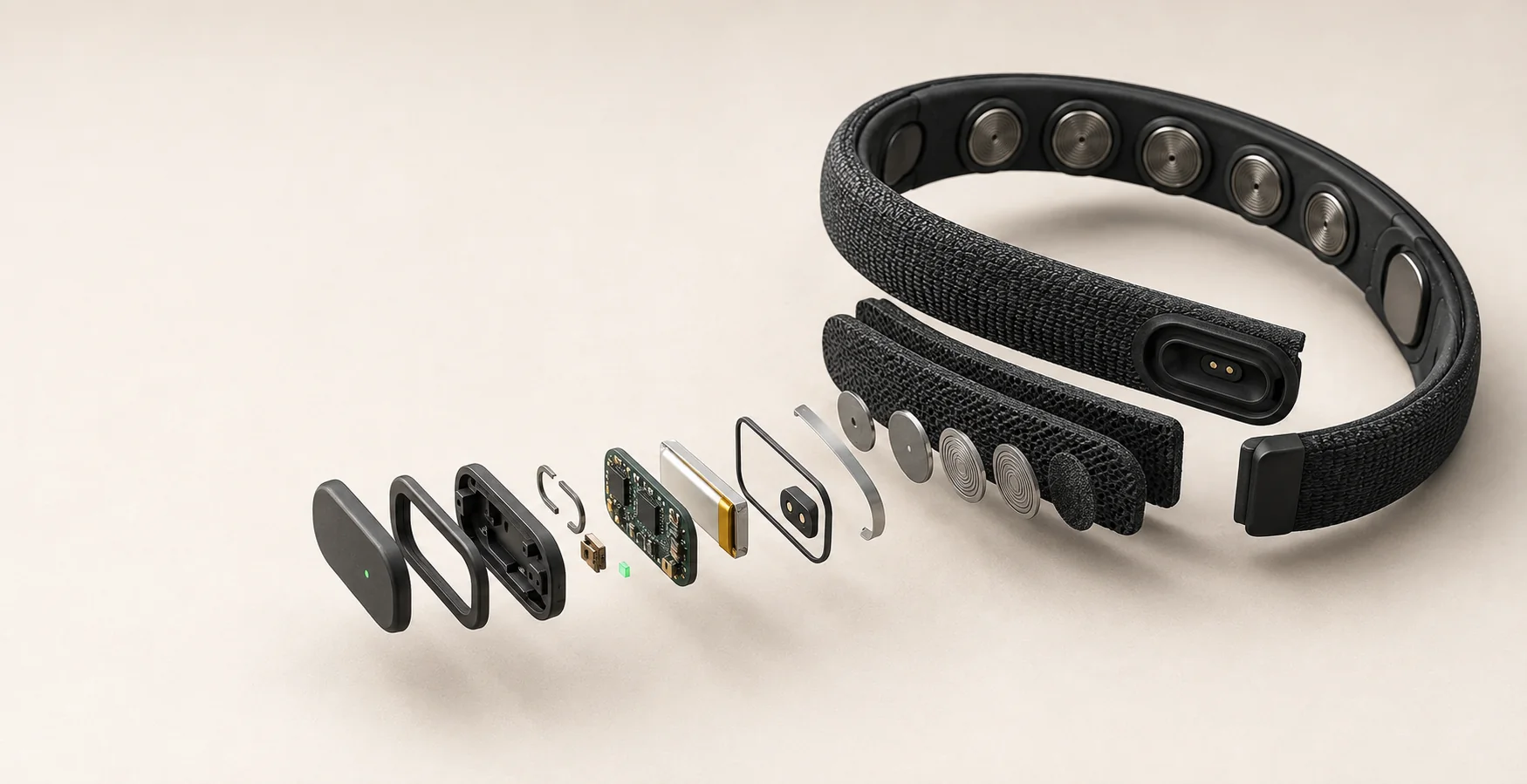
Dry. Metal, conductive rubber or coated pins straight onto skin. Higher impedance, sensitive to pressure and movement, and it takes a few minutes after being put on for the reading to settle as the skin under the contact hydrates from its own moisture. In exchange it can be worn nightly without preparation, which is the only reason home EEG exists at all.
Semi-dry and saline. A small reservoir of saline solution or a hydrogel pad. Between the two on both quality and convenience, and typically good for a night rather than a week.
Every channel is a difference between two points, and one of them is usually a shared reference — often the mastoid behind the ear, the earlobe, or a point near the top of the head. There is a separate ground or bias electrode, which in modern designs actively drives the body to keep it near the amplifier's operating range.
Two things follow. A reference in a poor position degrades every channel at once, because every channel contains it. And the reference is never electrically neutral — it carries brain activity too, which is subtracted from everything else. Placing it over an active region makes that activity appear inverted everywhere else, an artefact that looks entirely convincing.
Clean skin. Oils and cosmetics are insulators, and a forehead at the end of the day is not a clean surface. Alcohol works.
Hair out of the way. A single strand between metal and scalp is a gap, and a gap is impedance.
Firm, even pressure — enough that the contact does not move, not so much that it becomes uncomfortable and gets adjusted all night.
And wait. A dry electrode that reads badly for the first two minutes is normal, and a reading taken before it settles is a reading of the settling.
Common questions
An EEG electrode that makes contact with the skin without conductive gel. Metal, conductive rubber or coated pins sit directly against the scalp or forehead. It is what makes a wearable possible, because gel needs applying, abrading and washing out.
No, and the difference is measurable. A dry contact has roughly an order of magnitude higher impedance than a gelled one, it is more sensitive to movement and pressure, and it takes a few minutes to settle after being put on. What it buys is a device somebody will actually wear every night, which is the trade the whole category rests on.
Clinical practice traditionally aims below 5 kΩ, and modern high-impedance amplifiers tolerate considerably more. The number matters less than the match: two electrodes at 20 kΩ each will usually outperform one at 2 kΩ paired with one at 20 kΩ, because common-mode rejection depends on the two inputs being balanced.
Because Ag/AgCl is non-polarisable — charge crosses the boundary by a reversible reaction rather than piling up as a charged layer. That means far less slow drift, and since much of the interesting EEG sits below 4 Hz, drift and signal would otherwise occupy the same range.
Further reading