Guide
The one population that cannot tell you how it feels.
Animal EEG is well established in veterinary research and almost absent from ordinary practice. The reasons are practical rather than scientific, and most of them are about fur.
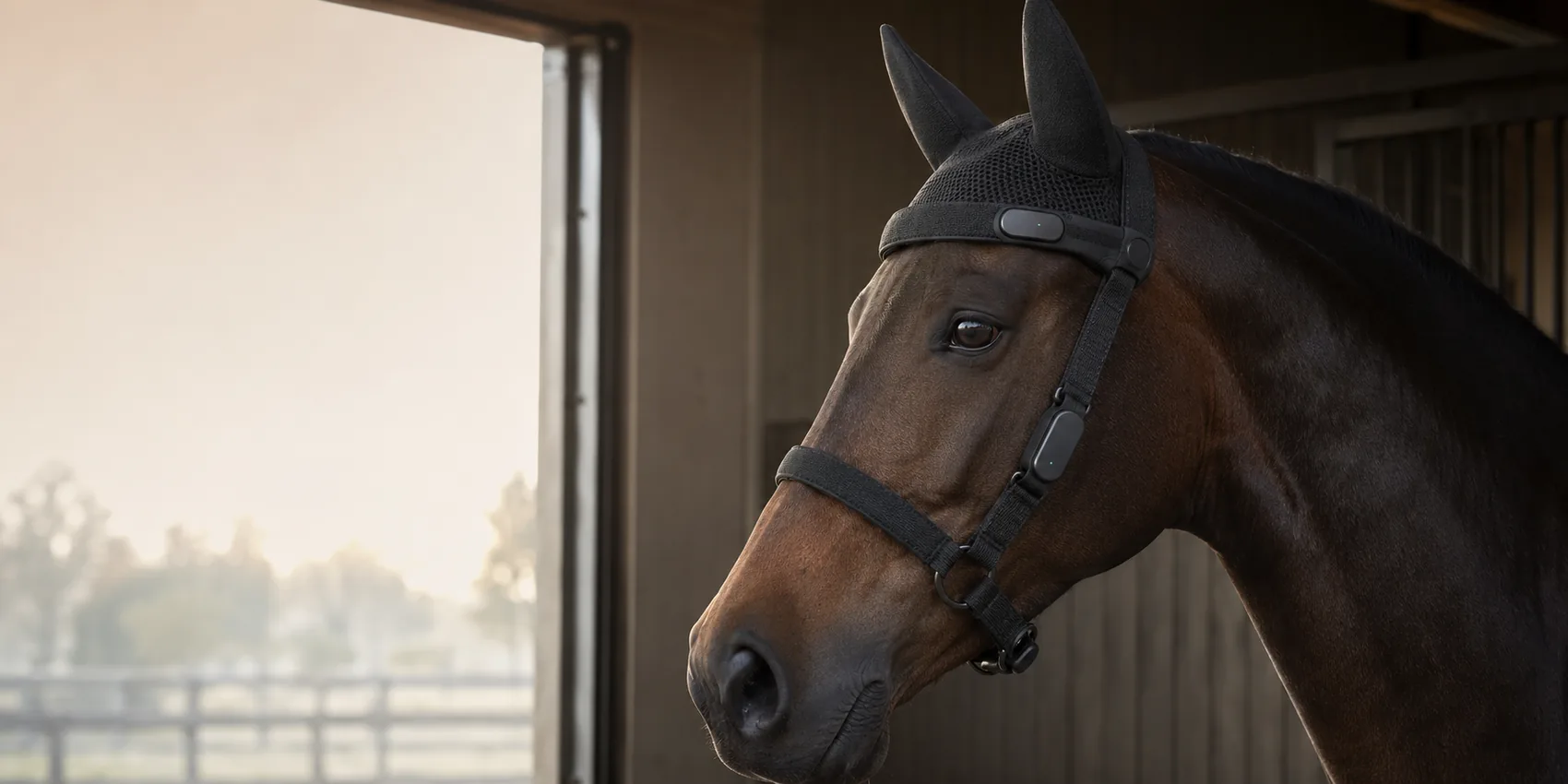
Guide
Animal EEG is well established in veterinary research and almost absent from ordinary practice. The reasons are practical rather than scientific, and most of them are about fur.
EEG in animals is not new. It is standard in veterinary neurology referral centres, it underpins a large research literature on sleep across species, and much of what is known about mammalian sleep architecture was established in animals before it was confirmed in people.
What is rare is routine, continuous, non-invasive EEG on an animal going about its life. The obstacles are almost all mechanical.
Fur. The dominant problem. Hair is an insulator, and an animal cannot be asked to sit still while it is parted. Veterinary EEG typically uses subdermal needle electrodes — thin needles just under the skin, usually under sedation — which is entirely reasonable for a diagnostic procedure and impossible as a nightly wearable.
Skull anatomy. The 10–20 placement system assumes a human head. Skull shape, thickness and the underlying cortical geometry vary enormously between a greyhound, a bulldog and a horse, so there is no single scheme and considerably less standardisation.
Movement and interference. An animal that is awake moves constantly, chews, shakes and scratches, and every one of those produces artefacts far larger than the EEG. Equipment gets rubbed off on fences and furniture.
No self-report. The point of the exercise and its central difficulty at once. There is no one to say "I was awake then", so validating anything requires video, direct observation, or an accepted behavioural standard.
Epilepsy. The strongest clinical case, and much the same as in humans. Seizure disorders are common in dogs, EEG can distinguish seizures from other episodic events that look similar to an owner, and an objective record is more reliable than a recollection of a frightening two minutes.
Sleep research. Substantial and well established. Dogs have been studied non-invasively with surface electrodes in laboratory settings, and sleep in horses, cattle and sheep has a long research literature.
Anaesthetic depth. EEG-derived indices are used in veterinary anaesthesia much as in human practice.
Welfare assessment. The most active research frontier and the least settled. Sleep disruption is a plausible objective indicator of poor welfare, and turning that into a validated per-animal measure is very much work in progress.
Dogs sleep polyphasically — many bouts across the day and night rather than one consolidated block — so a "night" is the wrong unit for a dog.
Horses can doze standing, supported by the stay apparatus in their legs, but cannot reach REM without lying down, because REM abolishes muscle tone. A horse that will not lie down is REM-deprived regardless of how many hours it spent apparently resting, and lying time is therefore a more informative measurement than total rest. That is its own guide.
Cattle and sheep are ruminants, and rumination is a distinct behavioural state that is neither sleep nor ordinary wakefulness, occupying many hours a day and complicating any simple sleep-wake classification.
Continuous non-invasive animal EEG is a genuinely unsolved engineering problem, and the science that would sit on top of it is much less mature than the human equivalent — which is itself less mature than most products imply. The welfare case for solving it is strong: an animal cannot report pain, disturbance or distress, and an objective, continuous, boring record is exactly what is missing.
That is a reason to work on it, not a reason to claim it already works.
Further reading