Guide
Almost nobody knows they do it.
Sleep bruxism is usually discovered by a dentist looking at worn enamel, years after it started. The jaw muscles are loud enough to measure — just not from a wrist.
Guide
Sleep bruxism is usually discovered by a dentist looking at worn enamel, years after it started. The jaw muscles are loud enough to measure — just not from a wrist.
Sleep bruxism is clenching or grinding the teeth while asleep. It is common, it is largely involuntary, and the person doing it is asleep at the time — which is why the usual route to finding out is a dentist noticing wear, or a partner mentioning the noise.
Current thinking treats sleep bruxism as a masticatory muscle activity occurring during sleep rather than as a disorder in itself. It is not the same thing as awake bruxism, which tends to be sustained clenching during concentration or stress and has different causes and different management.
Most episodes cluster around brief arousals — the short shifts towards lighter sleep that happen naturally through the night — and are often accompanied by a rise in heart rate. That association matters, because it means bruxism is not a random event but part of the architecture of the night.
A wrist device has movement and an optical pulse. Jaw muscle activity produces neither in any distinctive way, so grinding is essentially invisible to it. Some devices infer arousals and will show a fragmented night, but that tells you the night was disturbed without telling you what disturbed it.
The laboratory approach records electromyography from the jaw muscles, usually alongside audio and video, and that remains the reference standard. Portable single-purpose recorders exist and are used for exactly this.
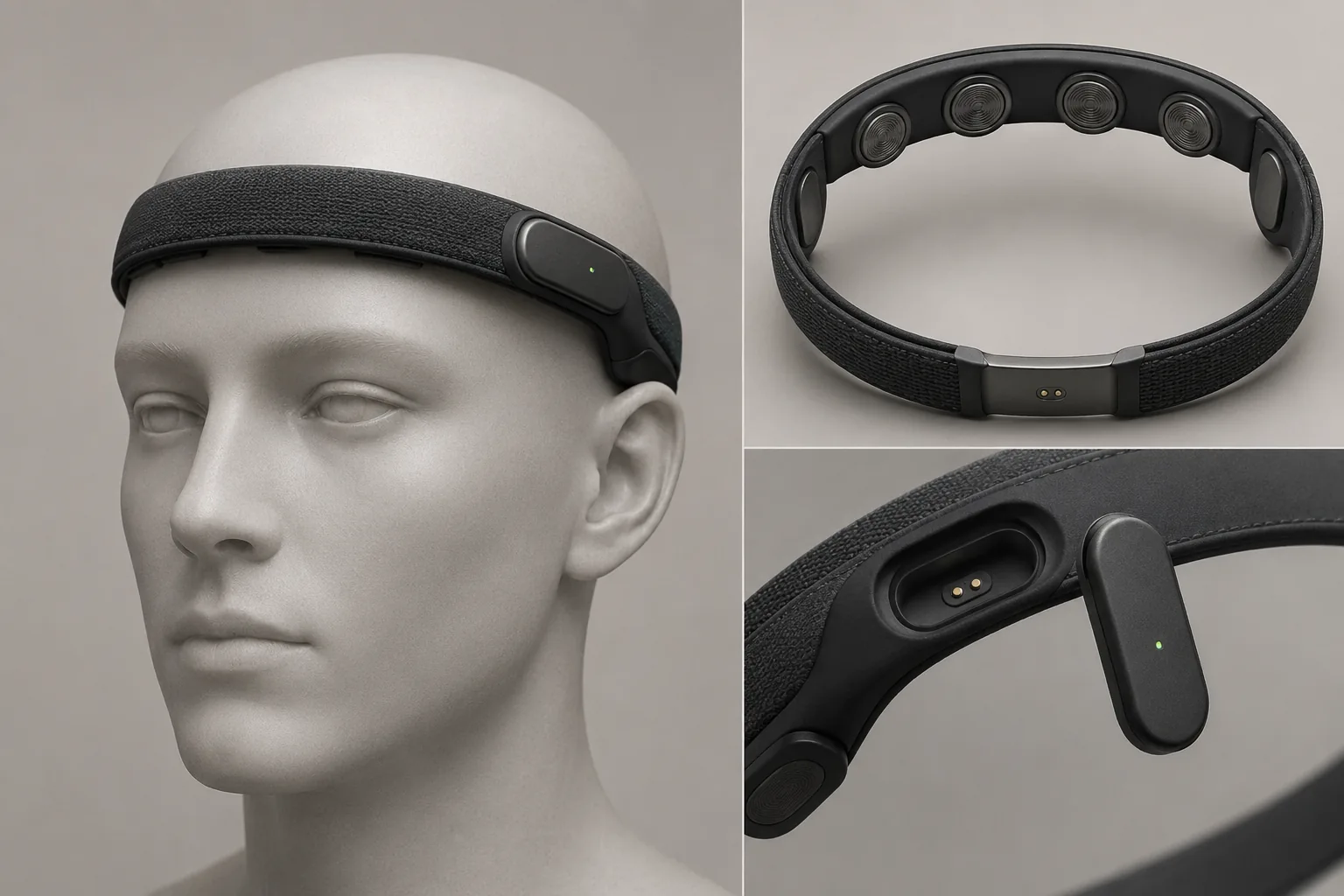
The reason a forehead sensor can see it is slightly accidental. Electrodes placed to record brain activity also pick up muscle activity, and the jaw muscles are loud in that frequency range — considerably louder than the brain signal underneath. In most EEG work that is an artefact to be removed. Here it is a second measurement you get for free, from contacts that were going to be there anyway.
Not for diagnosis. A minute count per night is useful for two narrower things.
The first is noticing at all, years earlier than a dentist would. The second is testing what changes it, because the associations above are population-level and you are one person. Alcohol on a Friday, a stressful fortnight at work, a change in bedtime — these are all testable against your own record over a couple of weeks, and the answer is frequently more specific than the general advice.
Our own threshold for saying anything is twenty minutes a night most nights, at which point a dentist is the right next step — for a splint to protect the enamel, and to check what the wear already looks like. A guard stops the damage; it does not stop the grinding, and nothing measured by a headband will either.
The clenching figure sits alongside the rest of the night in what we build for sleep, which is the point: an isolated grinding number tells you less than the same number next to what the sleep around it was doing. How much to trust any of those numbers is a fair question and we answered it.
Common questions
Most people find out from a dentist noticing wear, or a partner hearing it. Jaw ache or tiredness in the morning, temple headaches on waking, teeth sensitive to cold and flattened edges are the signs.
It is associated with stress and anxiety, alcohol, caffeine and smoking, some medications, and with sleep-disordered breathing — though whether that association is causal is not settled.
Not from the wrist: jaw muscle activity produces no distinctive movement or pulse signature. Forehead electrodes placed to read brain activity also pick up jaw muscle activity, which is loud in that range.
Further reading